
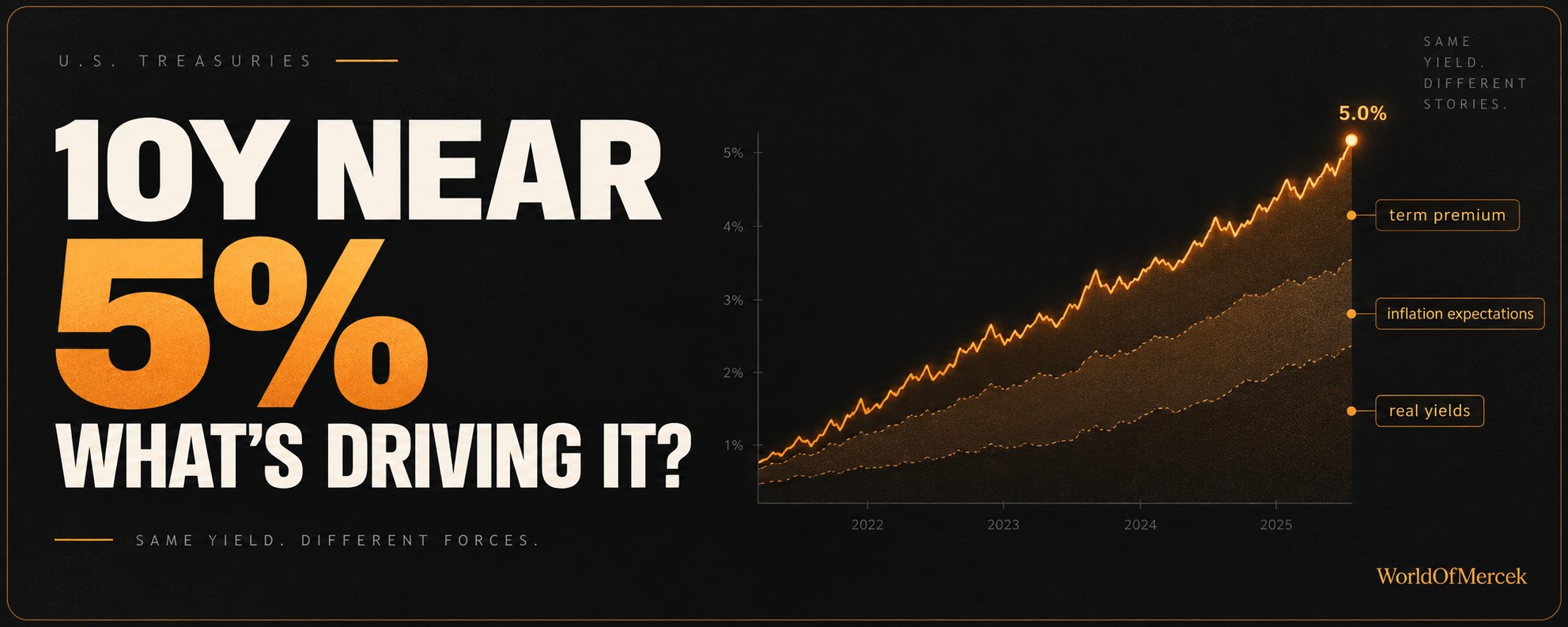
A rising 10Y yield doesn't always mean the same thing. The U.S. 10-year Treasury yield is approaching 5% again. For most investors, that number alone sounds bearish.
Higher yields mean tighter financial conditions, more expensive borrowing and a higher discount rate for assets whose value depends heavily on future growth.
All true.
But I've found that the level of the 10Y is often less useful than understanding why it is moving there.
- A 10-year yield rising because inflation expectations are breaking higher is one market.
- A 10-year yield rising because real rates are climbing is another.
- And a 10-year yield rising because investors suddenly want more compensation to own long-duration government debt can tell you something else entirely.
The chart looks the same. The diagnosis doesn't.
And with the Fed meeting on September 15-16, I think that distinction matters much more than usual.
Start by Taking the Yield Apart
The easiest way to think about a nominal Treasury yield is:
Nominal yield ≈ real yield + expected inflation
| Component | What it tells us |
|---|---|
| Nominal yield | What you see quoted on the screen. |
| Inflation expectations | How much inflation the bond market is pricing over the relevant horizon. One common way to observe this is through breakeven inflation. |
| Real yields | What investors can earn after accounting for expected inflation. |
That difference matters a lot for markets.
If nominal yields are rising mostly because inflation expectations are moving higher, the market is questioning the future purchasing power of money.
That second environment can be particularly uncomfortable for long-duration assets.
A company whose valuation depends heavily on profits many years into the future becomes less valuable when those future cash flows are discounted at a higher real rate. Crypto tends to care as well because liquidity and the opportunity cost of capital matter enormously for speculative assets.
Then there is another piece I watch: term premium.
I wouldn't treat term premium as simply a third item to bolt onto the equation above. It is better thought of as the additional compensation investors demand for accepting the uncertainty of holding a long-duration bond.
That uncertainty can come from several places:
- Large fiscal deficits.
- Heavy Treasury issuance.
- Uncertainty about future inflation.
- Questions around fiscal credibility.
- Or simply a market that no longer wants to lock money away for ten years at the same price.
This is where looking at “the 10Y” as one number starts becoming inadequate.
The Current Move Is More About Real Rates Than Inflation Expectations
This is what makes the current Treasury move worth paying attention to.
The 10-year yield has pushed toward 5%, reaching roughly 4.95% today.
But the recent increase has not simply been an explosion in inflation expectations. A large part of the move has come through higher real yields.
That is an important distinction.
It means the bond market isn't only saying:
“Inflation is going to be higher.”
Recent market analysis reaches a similar conclusion: the increase in Treasury yields has been driven primarily by real rates rather than a comparable surge in inflation expectations.
And that creates an interesting problem for the Fed.
The Fed and the Bond Market Can Tighten at the Same Time
Markets now strongly lean toward another 25 bp hike at this week's FOMC meeting after the latest inflation data shifted expectations sharply toward tightening.
I can understand the argument for it.
Inflation is still above target, energy has added another source of pressure and the Fed has a credibility problem if markets begin believing it will tolerate another inflation acceleration.
But what happens after that first move is more interesting to me.
The Fed controls the short end of the curve much more directly. The market has much more influence over the long end.
So imagine the Fed raises its policy rate while real yields and term premium continue pushing long-term borrowing costs higher independently.
You effectively have two tightening mechanisms operating at once.
The Fed is tightening the front end.
The bond market is tightening the long end.
That doesn't automatically mean the Fed shouldn't hike.
It means that blindly extrapolating one hike into a long hiking cycle becomes much more dangerous if financial conditions are already tightening elsewhere.
This is why “10Y is rising, therefore the Fed needs to be more hawkish” isn't enough of an analysis for me.
You need to know what is pushing the 10Y higher first.
The First Thing I'll Check After the Fed Decision
We won't need to wait weeks after the meeting to get an initial read on what the market thinks happened.
I'll start with something much simpler: the relationship between the 2-year and 10-year Treasury yields.
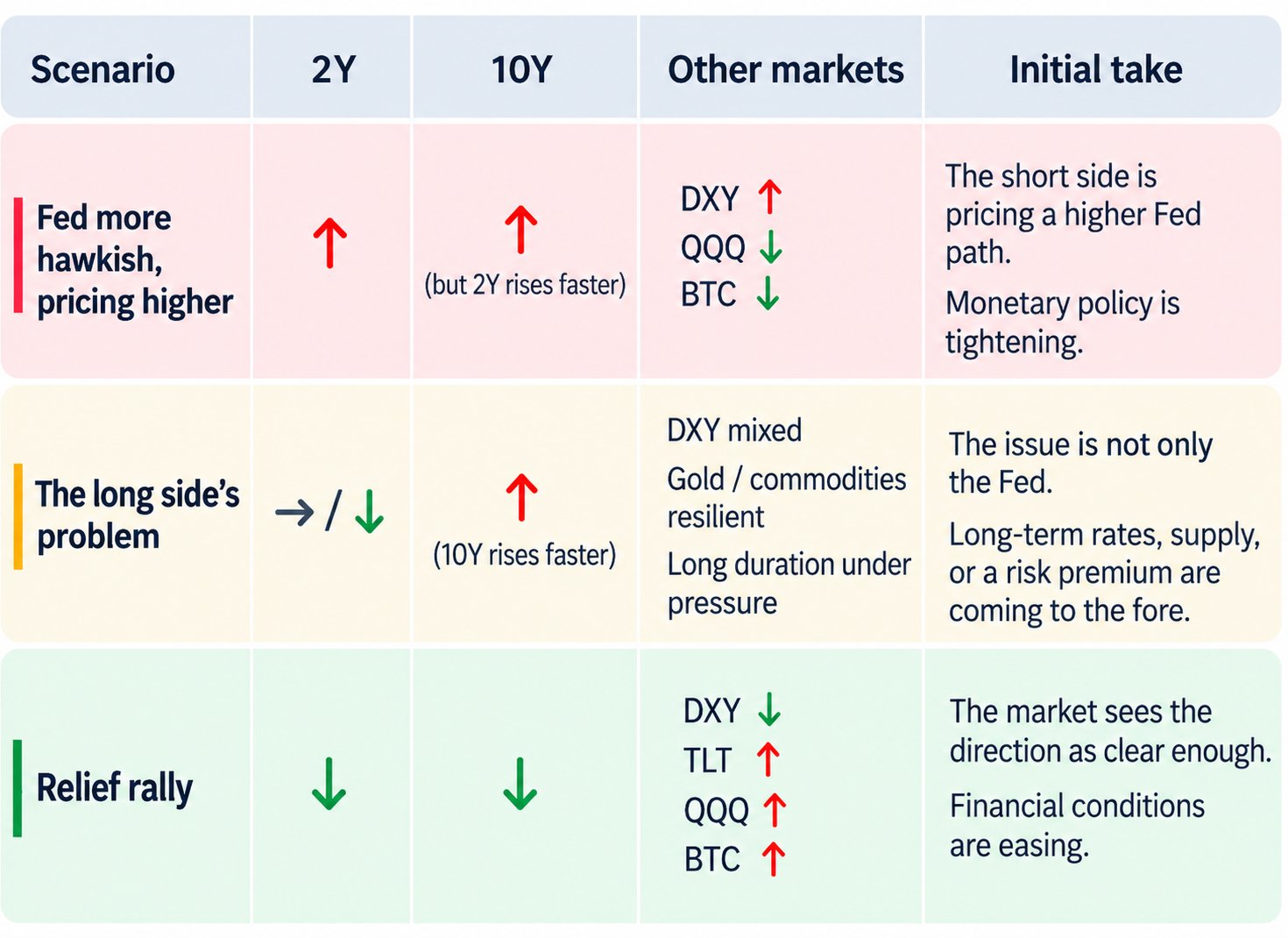
The 2Y is much more sensitive to where investors think Fed policy is going over the next few meetings.
The 10Y has to absorb much more than that. Growth, inflation, fiscal policy, Treasury supply and compensation for holding duration all matter further out on the curve.
That gives us a useful way to read the first reaction.
If both rise, but the 2Y rises faster
My first interpretation would be that the market heard a more hawkish Fed than it had priced. The front end is repricing the policy path upward.
If DXY strengthens at the same time while QQQ and BTC weaken, the message becomes cleaner. Monetary policy expectations are doing the tightening.
If the 2Y falls but the 10Y keeps rising
I would find this much more interesting. The market may be comfortable with what the Fed is doing in the near term while remaining uncomfortable with the longer-term picture.
Maybe Treasury supply is the issue. Maybe fiscal risk is being repriced. Maybe investors simply demand more compensation for duration.
Whatever the exact combination, the important point is that the Fed is no longer the main explanation for the move. That is a very different market from a conventional hawkish repricing.
If both yields fall
This would be the cleanest outcome for risk assets.
If 2Y and 10Y move lower together, DXY weakens, TLT rises and QQQ and BTC strengthen, I'd read that as the market deciding that the Fed has done enough for now. Financial conditions would finally be moving in the easier direction.
But I wouldn't put too much weight on the first five-minute candle after the announcement. The press conference can reverse the initial interpretation, positioning can distort the first reaction and different parts of the curve may need time to settle.
I'd rather see what survives the first day or two, and preferably the weekly close.
Same Yield, Different Market
This is probably the biggest lesson I've learned from watching bonds alongside crypto and equities.
A yield level by itself doesn't tell you enough.
A 5% 10Y produced by rising inflation expectations doesn't have the same implications as a 5% 10Y produced by rising real rates. And neither is identical to a 5% 10Y being driven by investors demanding a larger premium for long-duration government debt.
The number on the screen can be identical while the trade underneath it is completely different.
That's why after this week's Fed meeting I won't just be asking whether Treasury yields went up or down.
I'll be watching which part of the curve moved first, which part moved further, and what moved with it.
The 2Y can tell us that the market is repricing the Fed.
The 10Y can tell us when the problem has become bigger than the Fed.
This article reflects my personal market interpretation and is for informational purposes only. It is not financial advice. Market relationships can change across regimes, and the scenarios discussed above are not predictions.