
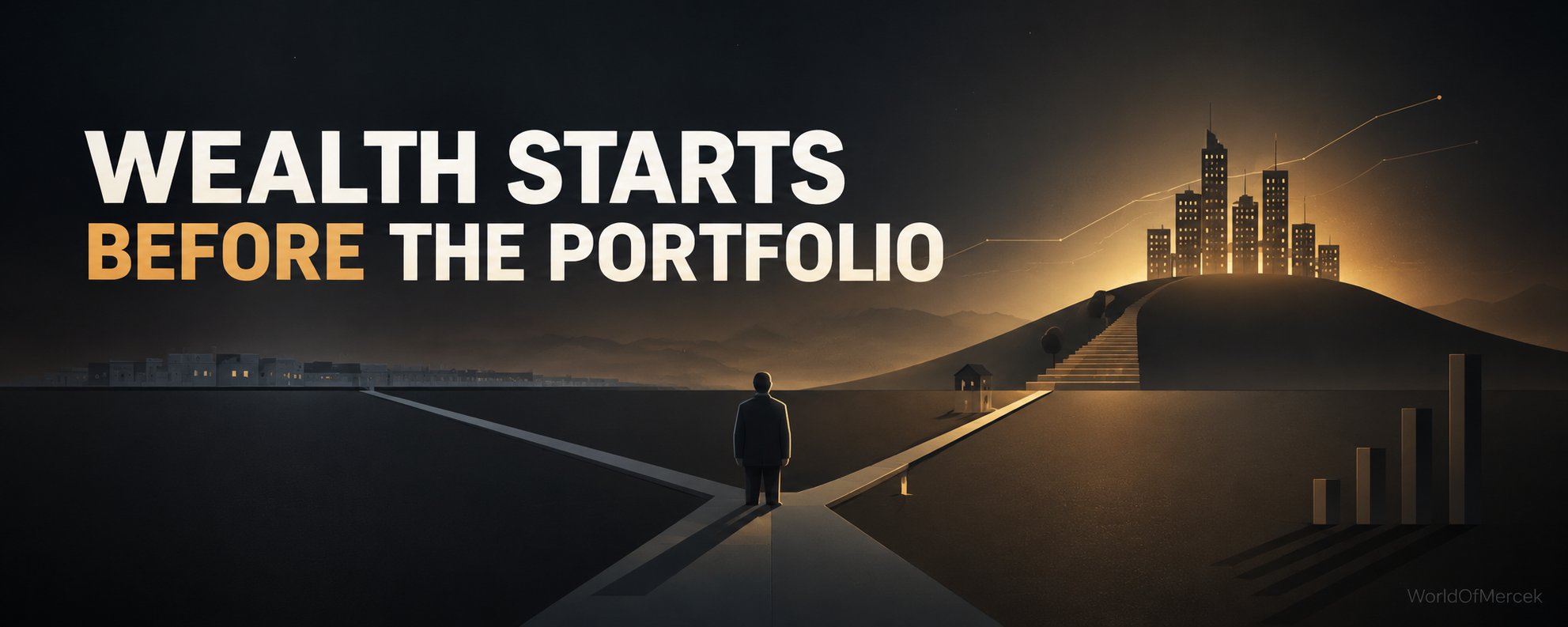
Most wealth advice starts with a portfolio. Which ETF should you buy? How much should you save every month? How should you diversify? What return can you reasonably expect over the next 20 or 30 years?
All useful questions, but they assume you already have enough capital for those decisions to matter.
If you're starting with very little, optimizing a portfolio can easily become a distraction from the much bigger variable: how much money you're actually capable of producing and investing.
That doesn't make investing less important. It just means wealth building has stages, and the first one often starts long before you have a serious portfolio.
Your income is the first engine
When there isn't much capital yet, income does most of the work.
The goal is simple enough: widen the gap between what you earn and what you need to live. That gap eventually becomes the money you can invest, take risks with, or use to build something larger.
How you widen it will depend on your situation. For one person it might mean learning a skill with better earning potential. For someone else it could be changing jobs, freelancing, starting a business or adding another source of income.
What matters more is not treating your current earning power as something fixed.
I think people sometimes put enormous effort into saving another 5% while barely thinking about how they might earn 30% more. Both matter, but early in the process they don't have the same impact.
This is also why being young can be more valuable than it looks on paper.
You may not have much money, but you often have more freedom to experiment. Fewer dependents, fewer fixed obligations and more time to recover from something that doesn't work can make it easier to change careers, move somewhere new, build a business or spend a year becoming good at something.
That advantage disappears gradually as life becomes more complicated.
It doesn't mean youth should be spent taking random risks. It means there are periods in life when failure is relatively cheap, and it makes sense to use some of that flexibility.
The important part is understanding what kind of failure you're exposing yourself to.
Not every risk deserves the same name
Leaving a job for a better opportunity is risky. So is starting a business, changing careers or spending months learning something that may never become useful.
Those decisions can go badly, but they're usually recoverable. You can find another job. You can try another business. The skill you learned may turn out to be useful somewhere you didn't expect.
Both situations involve uncertainty, but the downside is completely different.
Markets made me appreciate this distinction more than almost anything else.
You can have a good long-term thesis and still manage a position badly enough that you never get to see it play out. With enough leverage, you can even be right about where an asset trades several years from now and still get liquidated tomorrow.
So when I think about risk now, I care less about whether something sounds aggressive and more about what happens if it fails. A decision that sets you back six months is not the same as one that removes your ability to keep playing.
Especially when you're young, taking more career or entrepreneurial risk can make sense precisely because you have time to recover. That logic doesn't automatically extend to financial risks capable of permanently destroying your capital.
The goal isn't to avoid uncertainty. It's to avoid confusing courage with ruin.

Be careful who defines "realistic" for you
There is a non-financial side to all of this too.
The people around you have a huge influence on what you think is realistic.
Most of the time that influence comes from a good place. Parents want stability for their children. Friends don't want to see each other make painful mistakes. Colleagues usually recommend paths they understand themselves.
But advice is always filtered through experience.
Someone who built a good life through stability will naturally place a high value on stability. Someone who has never run a business may look at leaving a secure job and see mostly downside. Someone who has never invested may see ordinary volatility and interpret it as danger.
The opposite can happen as well. A successful founder can become convinced everyone should start a company. A trader who made a fortune during one market regime can mistake favorable conditions for permanent skill.
This is why I try to understand where advice came from before deciding how much weight to give it.
- If someone is teaching me about business, I want to know what they actually built.
- If they're talking about risk, I'm interested in what happened when they were wrong, not only when they were right.
- If a strategy supposedly works, I want to know what it looked like during periods that didn't suit it.
You don't need to ignore people who chose a different life from the one you want. They can still teach you plenty.
But there is a difference between listening to someone and allowing their limits to become yours.
A lot of people use "be realistic" when what they really mean is "choose an outcome I already understand."

Sometimes that's good advice. Sometimes it isn't.
The thing that makes you wealthy may not be the thing that keeps you wealthy
Early wealth creation is often concentrated.
Someone becomes exceptionally good at one profession. Another person spends ten years building one business. Someone else catches an unusually good opportunity and gives it far more attention than anything else.
Focus is useful because meaningful progress is difficult when everything receives equal attention.
But once that concentration starts producing real capital, the risk changes.
A person can spend years getting wealthy through one business and then make the mistake of keeping almost everything they own tied to that same business forever. A trader can become successful through one strategy and assume the environment that rewarded it will never change.
At some point, the question stops being only how quickly you can grow. You finally have something worth protecting.
That's where diversification makes more sense to me. Not because it maximizes returns. It usually doesn't.
If you somehow knew with certainty which asset would outperform everything else over the next decade, spreading your money elsewhere would obviously reduce your return.
But certainty is the part we never get.
Diversification is partly an admission that the future can surprise you. You accept that you won't capture every bit of upside in exchange for making fewer individual mistakes capable of undoing everything.
The same idea applies to income. One salary can disappear. One business can slow down. One client can leave. One social platform can change its rules overnight.
Crypto has made this especially obvious to me because almost nothing here feels permanent for very long. Narratives disappear, platforms lose relevance, business models become crowded and entire areas of the market can go from overflowing with opportunity to almost completely quiet.
That's why having several sources of income interests me much more as risk management than as some "passive income" fantasy.
You don't need seven businesses and twelve side hustles.
You just don't want one broken pipe to shut off all the water.

Starting early isn't only about compounding money
Everyone knows the usual argument for investing early: capital gets more time to compound.
That's true, but I think there's another benefit that matters almost as much.
You get to make your mistakes while they're still relatively cheap.
The first time you watch one of your investments fall 30%, you learn something about yourself that isn't available in a textbook.
The first time something doubles and you suddenly convince yourself you've discovered a permanent money machine, you learn something too.
You learn whether you panic easily. Whether you're capable of changing your mind. Whether your conviction is based on research or simply on the fact that price has been moving in your favor.
Those lessons become much more expensive later.
It's better to discover that your position sizing is terrible when the account is small. It's better to learn what greed does to your decision-making before the numbers become large enough to change your life.
This is one reason I don't think beginning investors need to obsess over making their first portfolio perfect. The early years are partly an education.
Time compounds capital, but it also compounds judgment.
Someone who has spent ten years making real decisions with real money has gone through market environments, mistakes and emotional reactions that are difficult to reproduce quickly.
Even bad investments can have some educational value when the loss is survivable and the lesson is understood.
The danger comes when the mistake is large enough that you don't get another chance to use what it taught you.
Faster isn't always better
We live in an environment that makes slow wealth creation look almost embarrassing.
Someone is always posting a trade that made 10x. Someone built a company in two years. Someone bought the right token early enough to change their life.
You mostly see the survivors.
The people who took similar risks and lost don't produce nearly as much content about it. There is no viral screenshot for the person who blew up, went back to work and spent three years rebuilding their savings.
That creates a distorted view of what "taking enough risk" is supposed to look like.
Leverage is probably the cleanest example.
It can make a great outcome spectacular, but it also changes how much time you are allowed to be wrong. Without leverage, a position can fall and you can reconsider. With enough leverage, the decision can be made for you.
That's a very different relationship with risk.
And as your capital grows, there is another question worth asking: how much does additional upside actually improve your life compared with what a large loss would take away?
The answer probably changes over time.
When you have very little, doubling your income or taking a calculated career risk can materially change your future.
Once you've already built meaningful wealth, risking all of it to reach the next number slightly faster becomes harder to justify.
The objective slowly shifts from maximizing acceleration to making sure one bad decision cannot erase years of progress.
The game changes before most people notice.

This is probably the part of wealth building I find most interesting.
There isn't one strategy that makes sense from zero all the way to financial independence.
Early on, your biggest asset may be your ability to earn more, learn faster and recover from mistakes. You can afford to be more aggressive in places where failure leaves you with another attempt.
The transition isn't clean.
You don't wake up one morning and suddenly become a completely defensive investor. Successful people still start companies, make concentrated bets and take risks.
What changes is the way those risks are judged.
When I had less, the upside of an opportunity naturally mattered a lot. As the amount at stake grows, the downside deserves more attention too.
That doesn't mean becoming afraid of losing money. It means understanding that the same decision can make sense at one stage of life and become unnecessary at another.
Building wealth and preserving wealth overlap, but they require different instincts. One rewards ambition, experimentation and concentration. The other asks for patience, diversification and the humility to admit that no opportunity is guaranteed.
Learning when to lean into each of those instincts is probably more important than finding the perfect investment.
Because the portfolio comes later. First you need something to put in it.
And once you have enough in there, the job slowly changes from getting rich to making sure you never have to start from zero again.
I used AI during the process of putting this article together, mostly to help me organize and refine some of the writing. But the ideas, opinions and conclusions throughout it come from my own experience with markets, crypto and building income over the years.
I put a lot of time into pieces like this. Thinking through the ideas, connecting them properly and turning everything into something worth reading takes much longer than it probably looks from the outside.
So if you enjoy these articles, a like or a comment genuinely goes a long way and lets me know the time is worth putting in.
And if you made it all the way down here, thank you for reading. I really appreciate it. See you in the next one.
Hmm... if I were a YouTuber, I'd probably have a much better outro than that. Writing doesn't give me much to work with lol.
Anyway, see you guys :)