
Bitcoin gets compared to two assets more than almost anything else. When markets are going up, it's often described as a higher-beta version of tech. When things start breaking, the conversation shifts and Bitcoin becomes digital gold.
I've never been completely comfortable with either description.
Not because Bitcoin can't behave like Nasdaq or gold for periods of time. It clearly can.
The problem is that if we're going to give Bitcoin one of those roles in a portfolio, the behavior should eventually show up consistently in the data.
If BTC is really a high-beta growth asset, I'd expect it to reliably outperform when risk assets are doing well.
So I went through the weekly data and tested both.
The result wasn't really what either narrative would suggest.
Bitcoin isn't giving you consistent upside leverage
I started with Nasdaq.
Rather than looking at correlation alone, I wanted to know what BTC actually does during strong equity weeks.
Since the beginning of 2025, there have been 12 weeks where the Nasdaq-100 gained at least 3%. BTC was positive in 92% of them.
That's pretty good.
But here's the part that changes the interpretation:
And BTC actually outperformed Nasdaq in only 33% of those weeks.
That's not quite what I'd expect from something we're supposed to think of as leveraged tech exposure.
Bitcoin participates. It just hasn't consistently given you extra upside for the extra volatility you're taking.
The downside tells a less comfortable story.
During the nine weeks since 2025 where Nasdaq fell at least 3%:
- Nasdaq averaged -4.3%.
- BTC averaged -6.2%.
BTC finished positive in only 22% of those weeks and outperformed Nasdaq in just a third of them.
So recently, the asymmetry has actually gone the wrong way.
Less upside than Nasdaq during the strongest weeks. More downside during the weakest ones.
That doesn't make BTC a bad asset.
It just makes "high-beta Nasdaq" an incomplete explanation for why someone should own it.
Follow the money instead
This is where the data gets much more interesting to me.
If Nasdaq isn't consistently explaining Bitcoin's upside, maybe we should stop trying to explain every BTC move through another asset and look at the capital entering Bitcoin itself.
The spot ETF era gives us a useful dataset for that.
When weekly US spot Bitcoin ETF flows have been positive, BTC has averaged roughly +3.2%, with 69% of those weeks finishing positive.
Increase the size of the inflow and the relationship gets stronger.
Now flip it around.
During weeks with negative ETF flows, BTC averaged approximately -3.6%.
And in the sample of 12 weeks where weekly outflows exceeded $1B, BTC didn't record a single positive week. Average return: roughly -7.0%.
That relationship is much harder for me to ignore.
It doesn't prove that ETF flows mechanically cause each move. There's an obvious feedback loop here. Rising prices can attract flows just as flows can contribute to rising prices.
But I think it tells us something important about Bitcoin's current financial identity.
BTC seems to respond particularly well when new balance-sheet demand is entering BTC itself.
That's different from simply saying "Nasdaq is going up, therefore Bitcoin should go up more."
And since January 2024, US spot Bitcoin ETFs have absorbed roughly $54.7B in net inflows in this dataset.
That's a lot of new capital entering through a channel that didn't exist before.
Then what about digital gold?
This one gets even more complicated.
If Bitcoin were already behaving like gold structurally, I'd expect their relationship to survive across longer periods and different market regimes.
It hasn't.
Weekly BTC/GLD correlation has generally been pretty weak:
Something interesting has happened recently though.
Over the latest 13-week window, correlation reached roughly 0.58, around the 94th percentile of observations since 2020.
That's worth paying attention to.
I just wouldn't call it a structural change yet.
Thirteen weeks can tell us that BTC and gold are currently responding to some of the same forces. It can't tell us that Bitcoin has permanently become digital gold.
There are plenty of reasons the two could temporarily converge:
- Dollar weakness.
- Lower real-rate expectations.
- Debasement concerns.
- Fiscal stress.
- A broader preference for scarce assets.
The real test comes when those conditions change.
Stress is where gold and Bitcoin still look very different
I think this is probably the cleanest comparison in the whole dataset.
Forget what we call the assets and just ask:
What happens when equities have a genuinely bad week?
Since 2018, there have been 58 weeks where Nasdaq fell by at least 3%. During those weeks:
Gold isn't some perfect hedge that magically goes up every time stocks fall.
But it has clearly behaved more defensively than Bitcoin when equity stress actually arrives.
That's a pretty important distinction.
Calling BTC "digital gold" because both assets rally during the same macro narrative is one thing.
So far, those are still very different behaviors.
But low correlation has value too
Here's where I don't want to take the argument too far.
Bitcoin doesn't need to become gold for it to have value alongside gold.
Historically, simply being different was enough to improve the portfolio in certain periods.
Using weekly rebalancing, a 90% gold / 10% BTC portfolio since 2018 improved CAGR from 14.2% to 16.7%. Sharpe improved from 0.92 to 1.02.
So adding a small amount of BTC helped.
During the ETF era, the improvement became much smaller, but it was still there.
Then something changed again. From 2025 onward:
| Period | Portfolio | CAGR | Sharpe |
|---|---|---|---|
| Since 2018 | 100% gold | 14.2% | 0.92 |
| Since 2018 | 90% gold / 10% BTC | 16.7% | 1.02 |
| From 2025 | 100% gold | 34.1% | 1.48 |
| From 2025 | 90/10 gold-BTC | 29.8% | 1.39 |
Adding Bitcoin actually made the portfolio worse over that particular period.
I think that's another useful reminder.
"Add 10% Bitcoin" isn't some timeless portfolio law.
Whether BTC improves a portfolio depends on the regime, valuation, correlation structure and, importantly, whether enough marginal demand exists to compensate you for the additional risk.
Maybe Bitcoin doesn't need to be either one
After looking through all of this, I think trying to force Bitcoin into the Nasdaq or gold box might be the wrong starting point.
The data doesn't give me a particularly clean answer for either.
- As a high-beta Nasdaq trade, the recent upside hasn't been consistent enough.
- As digital gold, its defensive characteristics still aren't strong enough.
But there's another way to think about it.
Bitcoin is a scarce asset with no issuer whose price is increasingly influenced by flows specific to Bitcoin itself:
- ETF demand.
- Corporate treasury demand.
- Potential sovereign reserves.
- Self-custody demand.
- Collateral use.
- Capital moving across borders.
- And potentially new forms of machine-driven economic activity, if BTC eventually becomes something autonomous agents actually need to hold or post as collateral rather than merely transfer.
Some of those demand sources barely existed a few years ago.
That makes Bitcoin less interesting to me as "better Nasdaq" or "digital gold" and more interesting as an asset whose marginal buyer can change dramatically from one regime to another.
The macro case is a little different too
There's another distinction I think matters.
Bitcoin isn't necessarily a hedge against today's fiscal problem.
High government debt doesn't automatically make BTC go up. High real yields and tight dollar liquidity can actually be pretty hostile conditions for Bitcoin.
The optionality comes from how policymakers eventually respond to those problems:
- Balance-sheet expansion.
- Pressure on long-term yields.
- Negative real rates.
- Financial repression.
- Capital controls.
- Currency debasement.
Those responses can create a very different environment for scarce assets.
So when people say Bitcoin is a hedge against the monetary system, I think they're skipping a step.
Bitcoin isn't necessarily trading the problem. It may be trading the eventual policy response to the problem.
That's a much more interesting distinction.
So what is Bitcoin today?
If I had to describe it based on the data rather than the narratives, I'd probably say this:
Bitcoin is scarce and issuerless at the protocol level.
At the market level, it's still heavily exposed to dollar liquidity, risk appetite and increasingly ETF flows.
And behaviorally, it can resemble Nasdaq in one regime and gold in another without permanently becoming either.
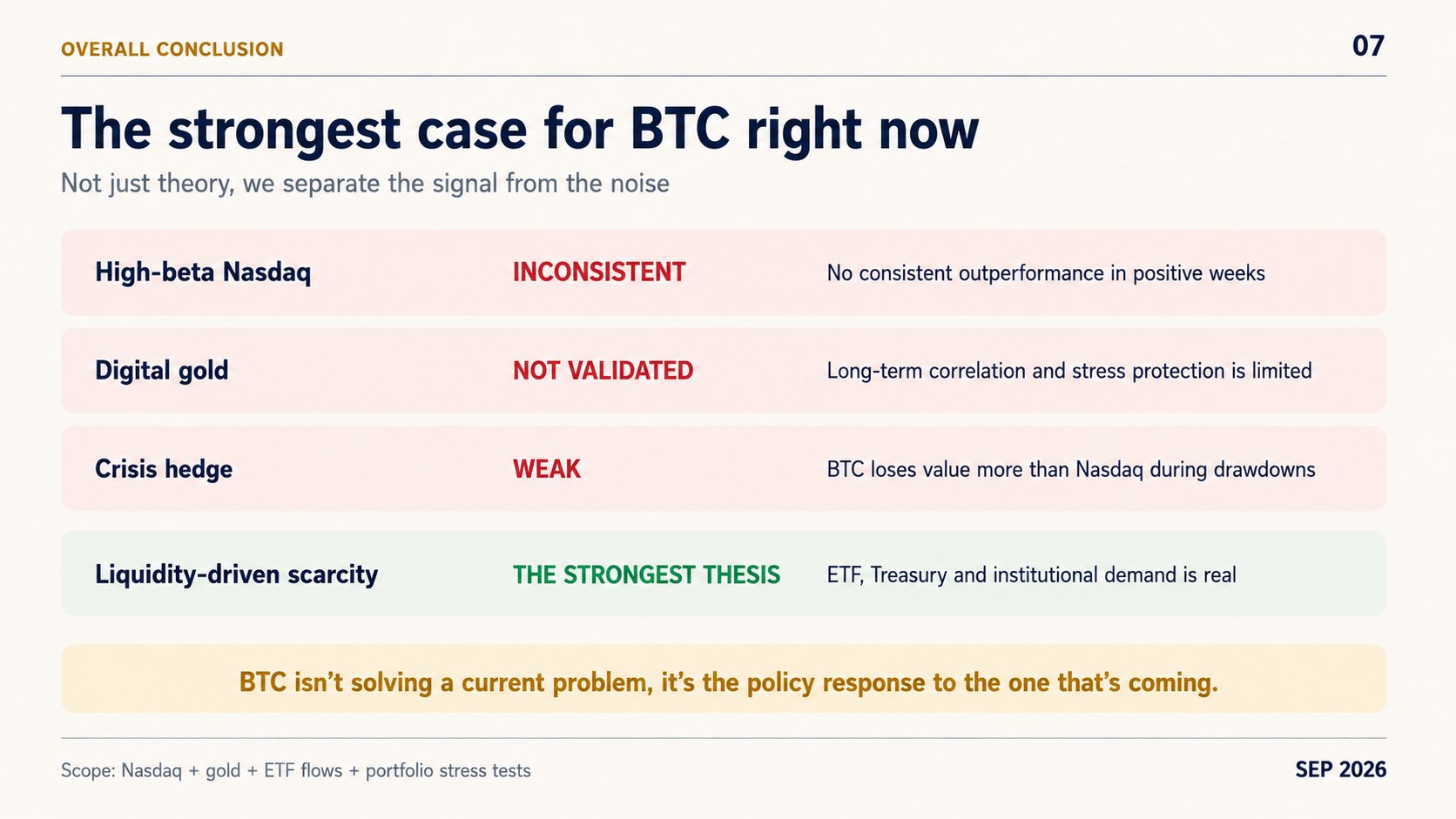
That makes me more comfortable thinking about BTC as a satellite position with asymmetric exposure to certain monetary, adoption and capital-flow scenarios, rather than automatically treating it as a replacement for either gold or growth equities.
And there are some pretty clear tests that could change my mind.
If Bitcoin can start passing those tests, then the "independent reserve asset" argument becomes much stronger.
Until then, I think the more interesting story is what has already happened.
Bitcoin didn't replace the financial system.
The next leg of Bitcoin's story may depend less on proving that 21 million is scarce. Everyone already knows that.
It may depend on how much larger the financial network willing to hold that scarcity can become.