
On Tuesday, October 13, one of CoreWeave's bonds traded at a 15% yield. That's the kind of rate the market usually saves for companies it isn't sure will pay it back, and CoreWeave is a company whose revenue just doubled and that has more than $100 billion of contracted work lined up. Three days later, the Financial Times reported that Anthropic had offered Blackstone a 10% coupon to help pay for its next batch of chips, up from 8.5% on a similar slice of debt four months earlier. Oracle had already been cut to the last rung of investment grade back in July.
Meanwhile, the S&P 500 set a record on October 6 and, even after its worst week since June, is only about 2% below it. Stock investors are still mostly focused on how big AI can get. Bond investors have started asking a different question, which is how much it costs to get there. That gap is what this piece is about, because economic trouble often shows up in what companies pay to borrow well before it shows up in stock indexes.
How the credit market prices risk
Lending money to a company is a simple trade at heart. You want your money back with interest, so the first thing you care about is whether the company can actually pay. Rating agencies try to answer that with a letter grade. AA means the company is financially very strong. BBB is the lowest grade that still counts as investment grade, and that line matters a lot, because a big share of pension funds, insurers and bond funds are set up to hold only investment-grade debt. From BB down you're in high yield, or junk. B-rated companies have much less room to absorb a bad stretch, and at CCC and below there are real doubts about whether the debt gets repaid at all.
Two things are worth keeping in mind here. A specific bond can carry a different rating than the company that issued it, and a low rating doesn't mean a company is going to default. It means the risk is higher, and lenders want to be paid for it.
That payment is the spread. Take the yield on a US Treasury as the baseline, since that's as close to risk-free as it gets in dollars, and whatever extra a company has to pay on top of it is its credit spread. Spreads are quoted in basis points, where 100 basis points is one percentage point. If a Treasury yields 5% and a company's spread is 300 basis points, that company borrows at roughly 8%. When spreads widen, the company's existing bonds lose value, and the next time it needs to borrow or roll over debt that's coming due, it pays more.
Where the AI borrowers sit
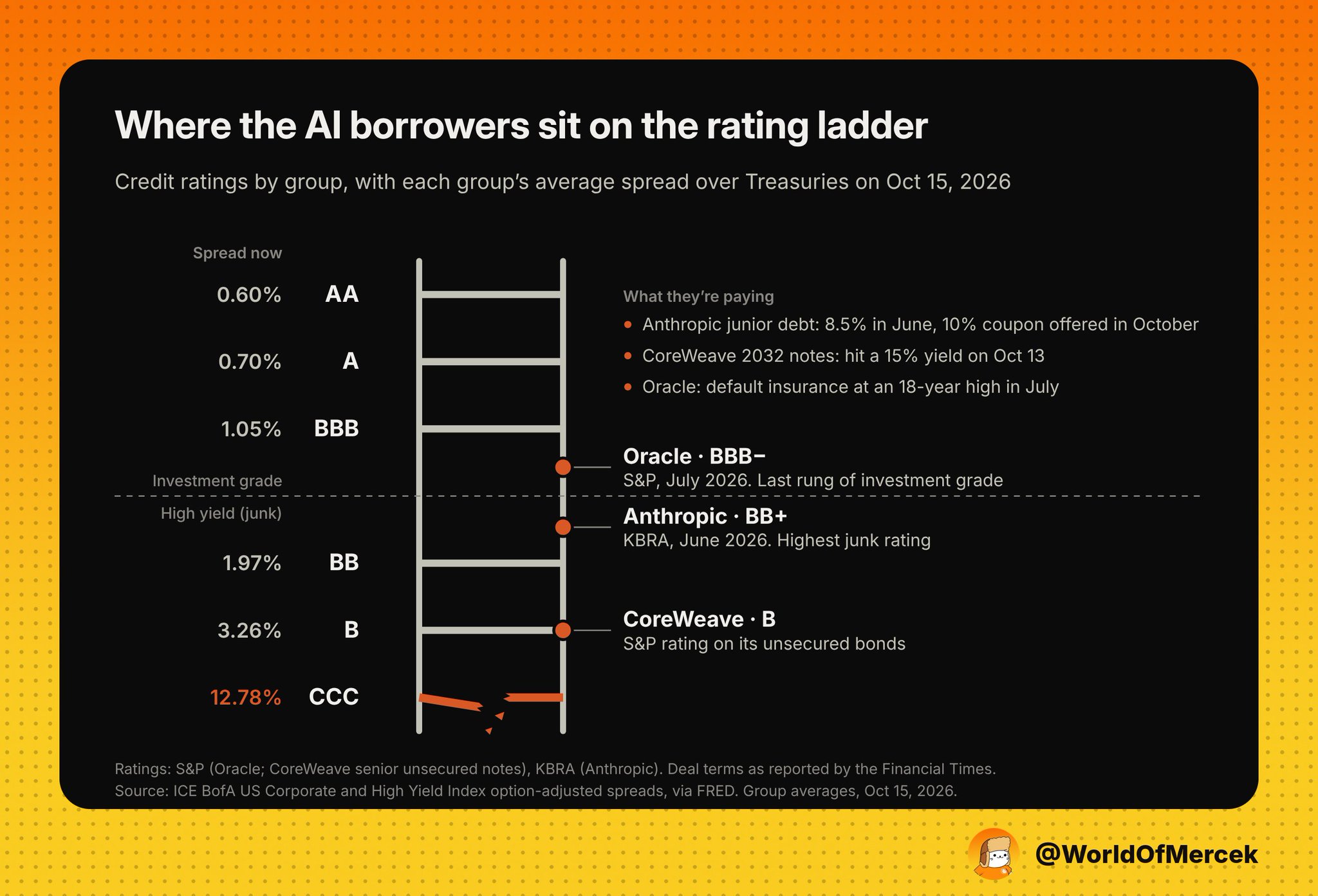
Put the three names from the start of this piece on that ladder, beginning with Oracle. It's still investment grade, but only just. S&P cut it to BBB- in July, the lowest investment-grade rating, pointing to rising debt and free cash flow that came in almost $24 billion negative in its last fiscal year while capex ran above $55 billion. S&P also estimates that roughly half of Oracle's $638 billion in contracted future revenue is tied to OpenAI, and later in July the cost of insuring Oracle's debt against default hit its highest level in almost 18 years. The reason this one rating matters so much is size. Oracle has around $117 billion of bonds in the main US investment-grade index, and if it ever lost investment grade, a lot of funds that can only hold investment-grade debt would have to sell.
Anthropic sits one notch lower. KBRA gave it a BB+ rating in June, the highest junk rating, and the price of its money has moved the wrong way since. In an earlier chip financing, a $4.4 billion slice of junior debt sold at around 8.5%. For its next deal, a $60 billion package to pay for about 1.5 gigawatts of Google's TPUs, the FT reports that Anthropic has offered Blackstone a 10% coupon on $9 billion of junior debt backed by its chip lease payments. The deal is still being negotiated, and for comparison, similarly rated companies pay about 7% in the public bond market.
CoreWeave is further down. S&P rates its unsecured bonds B, and last week the market priced them like something worse. Its 2032 notes hit a 15% yield during trading on October 13, and the stock fell more than 15% the next day. The numbers behind it explain the nerves. In the second quarter, CoreWeave's revenue doubled to $2.6 billion, but it paid $640 million in interest against $128 million of adjusted operating income, and it spent $6.4 billion on capex in those three months alone. The bonds bounced later in the week, but they're still trading well below face value.
Put the three side by side and they're facing the same question from different rungs of the ladder: will the revenue they expect to earn later cover what they're spending right now? Shareholders can live with a long wait if the upside is big enough. Lenders don't get any of that upside, so for them it comes down to whether the cash shows up in time.
What the October data says
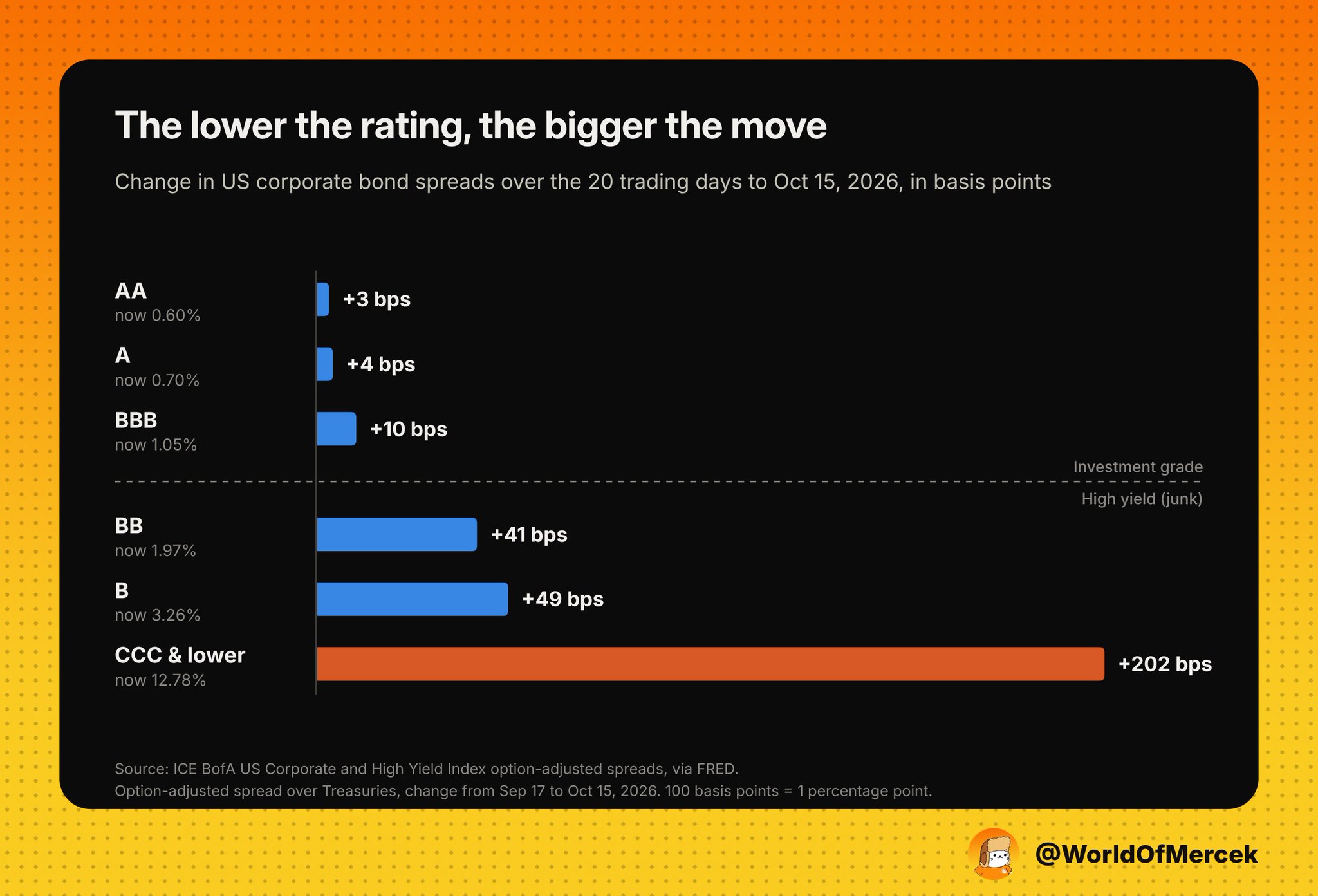
The credit market looks very different depending on which part of it you look at. Over the 20 trading days through October 15, AA spreads widened by just 3 basis points and BBB by 10. Further down the ladder the moves get a lot bigger: BB widened by 41 basis points, B by 49, and CCC and below by 202.
The CCC number is the one that stands out. That spread reached 12.82% on October 14, the widest in the three years of data FRED publishes for this index, and it was still at 12.78% the next day. That's wider than at the worst point of the April 2025 tariff shock, when it peaked at 11.37%. Every other rating bucket is still below its April 2025 peak, and the broad high-yield spread sits at 3.23%, against 4.61% back then.
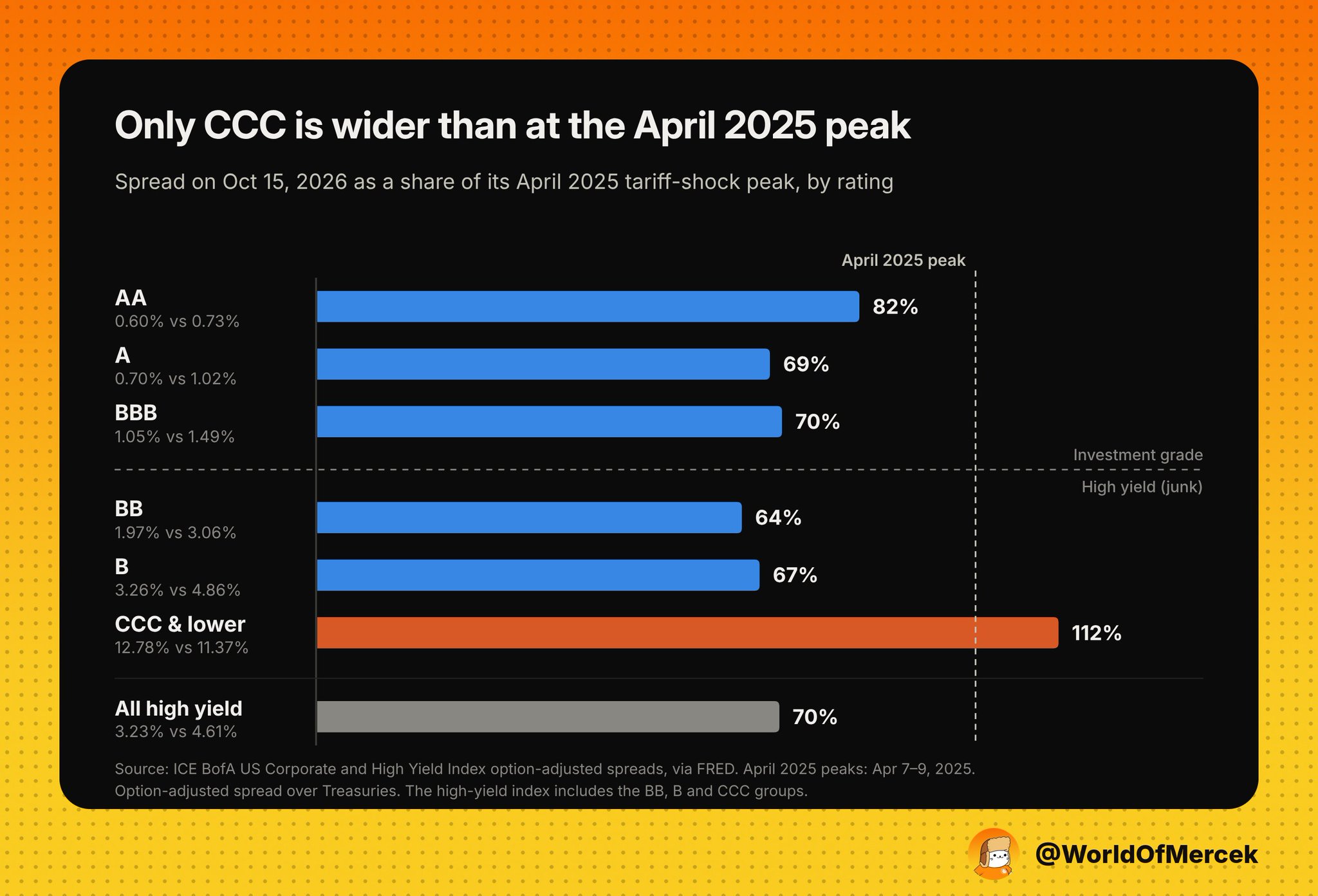
So this isn't a broad panic. The stress is concentrated in the weakest borrowers, which is often where these episodes start. What caught my attention is the last five sessions in the data, where spreads rose in every rating bucket, including AA and BBB. The moves at the top are still tiny, but that's the part worth watching from here.
When credit stress turns into something bigger
There's no fixed order to how downturns play out, but the mechanism usually looks something like this. High rates, slowing sales or rising costs squeeze cash flow first, and lenders start asking for more from the companies carrying the most debt. As borrowing gets more expensive, those companies delay investment, slow hiring and find it harder to roll over what they owe. If the squeeze reaches stronger companies too, the pressure on the wider economy grows with it.
In 2008, stress in credit spread through the whole financial system, and the high-yield spread hit a record 21.82% in December of that year. In 2020, the economy stopped almost overnight, spreads jumped to 10.87% by March 23, and they came back down once the Fed stepped in. So credit stress can be an early warning of a slowdown, or the thing that makes a slowdown worse once it has already started. Today's 3.23% is nowhere near either of those moments, which is why, right now, where the stress is matters more than how big it is.
What this means for crypto
For crypto, the closest link runs through the miners. CoreWeave itself started out mining Ethereum, and over the past two years a lot of bitcoin miners have turned into AI data-center landlords, paying for much of that shift with high-yield debt. TeraWulf sold notes at 7.75% and Cipher Mining at 7.125% and 6.125%, while regulated utilities borrow at around 4 to 5%. Earlier this year, miners were planning roughly 30 gigawatts of new capacity for AI, nearly triple what they were running at the time, and much of it was still at the planning stage. If lenders keep charging more further down the ladder, every one of those plans gets more expensive, and the weakest projects are usually the first ones to get pushed back.
The second link is less direct. Bitcoin doesn't trade off credit spreads, but it does trade off the same thing spreads measure, which is how much risk leveraged money is willing to carry. When lenders start demanding more from the weakest borrowers, the same kind of money tends to cut leverage elsewhere too, and crypto is often one of the first places that shows up, because it trades around the clock. As long as the widening stays at the bottom, that effect should stay limited. If it moves up into BBB, it becomes a different market for every risk asset, crypto included.
How I'm reading it
Lenders have started to separate the AI companies that can fund their buildout from the ones that need borrowed money to keep building.
I wouldn't call this a credit crisis, and the data doesn't support that yet. Investment-grade spreads have barely moved, the broad high-yield spread is far below where it was in April 2025, and AI companies are still able to raise enormous amounts of money. What the data does show is that lenders have started to separate the AI companies that can fund their buildout from strong balance sheets from the ones that need borrowed money to keep building, and that the weakest borrowers overall are paying more than they did at the worst of the tariff shock.
The part I'm watching most from here is BBB. It's the biggest slice of the investment-grade market and the bucket Oracle sits at the bottom of, so if BBB spreads start widening at the pace BB and B did over the past month, the pressure has moved from the weakest companies to the ones that carry a lot of the real economy. The other thing I'm watching is the price of the next AI deal, whether that's the rest of Anthropic's junior debt, which is expected to be offered to other investors in the coming months, or CoreWeave's next trip to the bond market. I'll keep following where stocks go, but for the AI trade specifically, what these companies pay to borrow is starting to tell me more than their share prices.
This article is for informational purposes only and isn't financial or investment advice. It reflects my own reading of public data and press reports as of October 2026, and ratings, spreads and deal terms can change quickly. Always do your own research before making any investment decision.