
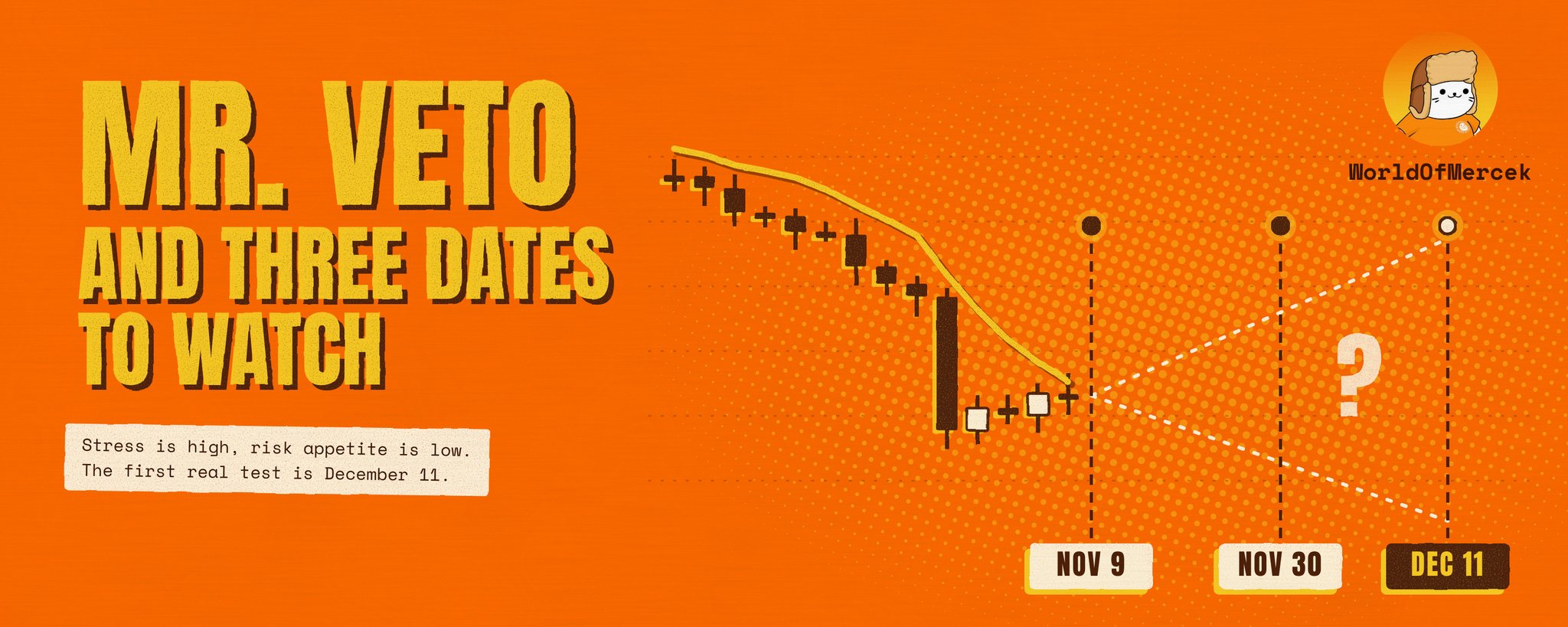
Democrats won Congress. Trump answered with a hat that says VETO. Markets now have three dates to get through, and the first real test is December 11.
One calm day, then the drop
On Wednesday, November 4, the morning after the US midterms, the Dow had its best post-midterm day in 44 years. Democrats had just taken both chambers of Congress, and the market's first reading was simple: divided government means fewer surprises.
That reading lasted about a day. On Thursday the S&P 500 fell 4.4%, its worst session since the tariff crash of April 2025, and the Nasdaq 100 dropped 6.4%. The VIX jumped from around 19 to 28 in a single session.
The trigger was mostly AI. Democratic wins in states like Texas, Georgia and Ohio raised the chance of tighter rules on data centers, weak chip earnings landed the same morning, and heavily leveraged funds had to sell. But the stress didn't fade once the selling stopped. As I write this on November 10, the indicators I follow show stress and uncertainty near their highest levels of 2026, while risk appetite sits near its lowest. The gap between the two is even wider than what we saw in February and March.
So are markets right to be this careful? It's hard to say they're wrong. The election changed more than the majority in Congress. Over the next few weeks, Washington has to make decisions that feed directly into the economy, rate expectations and markets, and it has to make them while the two sides are still working out how to deal with each other.
What Mr. Veto is really saying
Democrats won both the House and the Senate on November 3. The new Congress doesn't take its seats until January 3, 2027, though, so Republicans keep their current majorities for about two more months.
Trump didn't wait for January to set the tone. A few days before the vote he told the New York Post, "I guess I'll become Mr. Veto," and after the results he posted a red hat with the word VETO on it. He also said deals would probably come later, after a month or two of rejecting Democratic bills.
The math is on his side. A president can block any bill Congress passes, and overriding that takes two-thirds of both chambers. In the Senate that means 67 votes, and Democrats are on track for 54. So Democrats will be able to write and pass bills, but they'll struggle to turn anything Trump dislikes into law.
It cuts the other way too. Trump can't get new spending or new laws that need Congress without Democratic votes. Neither side can move alone, and both can stop the other.
A stalemate on its own isn't what worries markets. Stocks have often done fine under divided government. The issue is that some economic decisions come with deadlines, and a stalemate means they can slip.
Why the Miller appointment matters
On November 6, three days after the election, Trump replaced his chief of staff Susie Wiles with Stephen Miller.
Miller has been one of Trump's closest advisers through both terms, and he's best known for two things: the immigration crackdown and a very broad reading of what a president can do on his own. Putting him in charge of the White House right after losing Congress reads as a signal. Where Trump can't get agreement on Capitol Hill, expect more executive orders.
Democrats are preparing for the same fight from the other side. They're getting ready to investigate health spending, tariffs, the war with Iran and how federal agencies have been run, and the likely next chair of the House Oversight Committee has already said Miller "should lawyer up."
This is more than political theater. Fights over tariffs, energy policy and public spending change company costs, inflation expectations and investment plans. And the first tests won't wait for January.
Three dates before the handover
Between the election and the new Congress there are three dates I'm watching. Each one tests something different: what gets signed, how close the two sides are, and whether the government keeps running.
November 9: the two-month window opens
Miller started on Monday, November 9, the same day Congress came back to work after the election. That opens a window of about two months in which Republicans still control both chambers, and they may try to finish as much as they can before they lose it.
In this period I'd pay less attention to what Trump says and more to what actually gets signed and enforced. New steps on trade are the ones to watch most closely, because they feed into both inflation and growth expectations at a time when the Fed is already raising rates.
November 30: budget talks get serious
The second date is November 30, when the Senate is due back from its Thanksgiving break. No major data release is tied to that day. What matters is that the funding deadline will be less than two weeks away, and it should be clear by then how close the two sides are.
Democrats want health insurance subsidies, cost-of-living measures and some public spending protected. Republicans have a reason to push for a longer deal while they still hold the majority.
If all they can agree on is another short extension, nothing is solved. The problem just gets handed to the new Congress in January, and the political uncertainty moves into 2027 with it.
December 11, the first real stress test
The most important date is December 11. That's when the temporary funding bill keeping the federal government running expires. Several other programs expire with it, including highway funding and the national flood insurance program.
Without a new deal, parts of the government start closing on December 12. That hits public spending and federal paychecks, but for markets the bigger problem is usually the data.
We saw how that works a year ago. The shutdown that started in October 2025 lasted 43 days, the longest on record, and the government ended up cancelling the October inflation report and never published a full October jobs report. The Fed had to set policy with part of the picture missing.
A repeat would land at a worse moment. The Fed is hiking again, last Friday's jobs number came in far stronger than expected, and a December hike is still on the table. Losing jobs and inflation data in the middle of that would make every rate guess less reliable.
And if a shutdown drags on, it starts to weigh on the economy itself.
What this means for markets
There isn't one scenario here. A short budget standoff can be resolved quickly and leave no lasting mark. History is fairly reassuring on this: the S&P 500 has risen during almost every shutdown since 1995, including last year's.
The risk is a longer one. If the fight drags, growth expectations weaken or the data flow breaks, the pressure on risk assets builds. Treasury yields could go either way in that case. They could fall as money looks for safety, which is what happened last week when the 10-year slipped to 4.86%. Or they could rise if investors start worrying about the fiscal picture itself.
What decides the outcome for markets is how risk appetite and liquidity expectations shift along the way.
The difference from the stress we saw earlier this year is that markets now also face a new political balance, one the election made official. That's why falling prices alone don't explain today's high stress and low risk appetite. The economic consequences of what Washington decides in the next few weeks deserve the same attention.
The first real test is December 11.
See you in the next one.
Not financial advice, just how I read markets. Always do your own research before making any investment decision.